GeoGame in the classroom
The whole class races to the same hidden country — live. Everyone gets the same mystery country at the same time; every guess shows up on a 3D globe, coloured from icy blue (far away) to red (close), with the distance in kilometres, until someone turns it green. Free for schools: up to 30 players, one private link, no accounts, no ads.
The game is in English, German, French, Italian, Spanish and Portuguese: the language button switches it. Students can also type country names in their own language: German, French, Spanish, Italian, Portuguese, Dutch, Polish and nine other languages written in the Latin alphabet, with or without accents — for example “Schweiz”, “Suisse” or “Suiza”.
What your class learns
- Where countries are. Students don’t just recall names: they place each guess on the globe and see where it lies.
- Neighbours and regions. “Ethiopia is hot, so it must be next door”: students start reasoning with borders, regions and continents.
- Distances. Every guess shows how far it is from the hidden country, measured border to border. Over a few rounds, students build a feel for how big the world is and what lies close to what.
- Spelling country names. On Expert, students type the country’s name (with suggestions as you type), with no clicking on the map and no direction hints. Set “Find” to “Capitals” and the hidden one is a capital city instead: students type capitals.
Run a class party in 6 steps
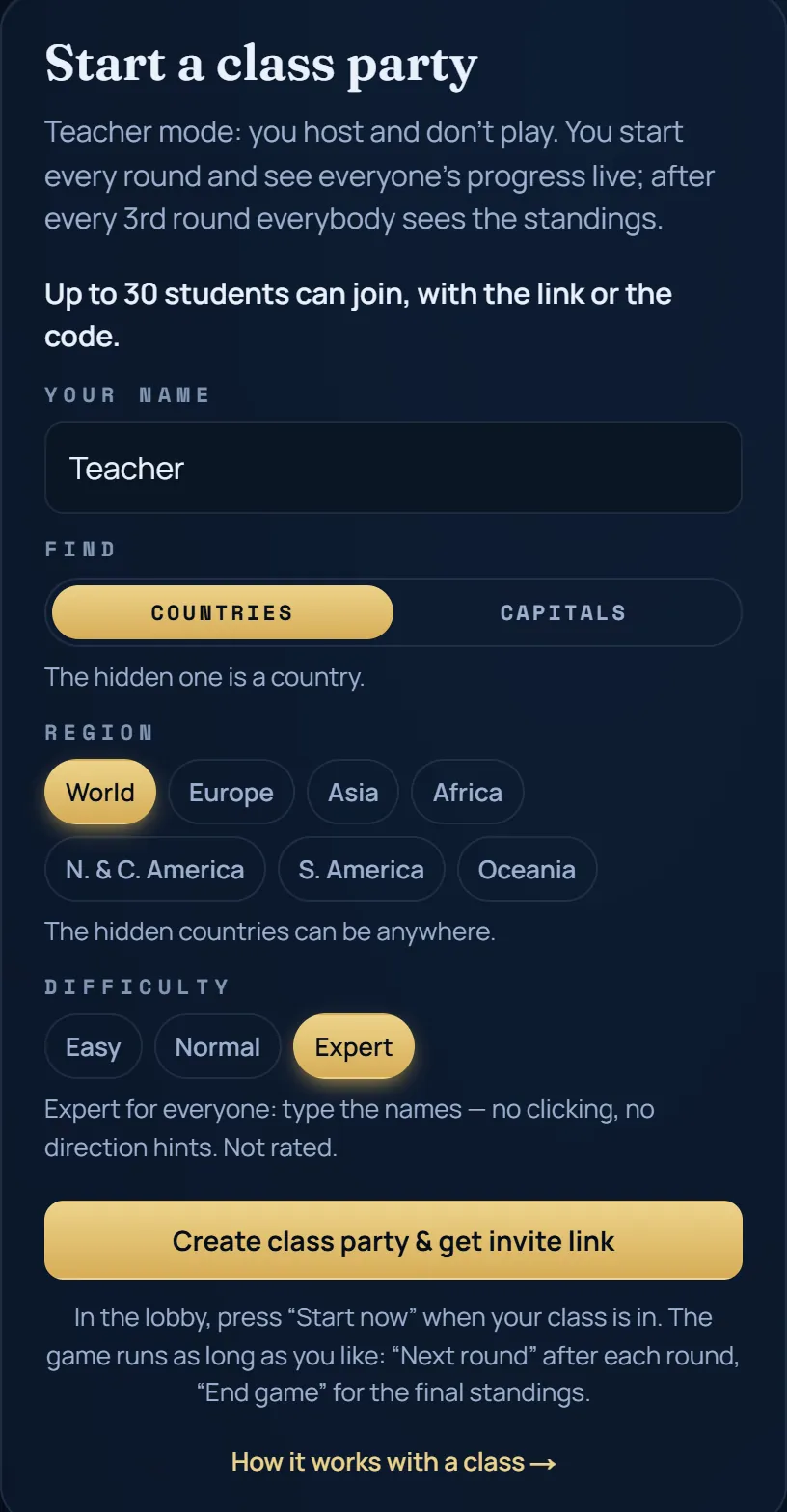
- Open the class form: the button above, or “For teachers →” on GeoGame’s Party page. Pick what to find (“Countries” or “Capitals”), the region (the whole world or one continent) and the difficulty: Easy helps younger classes, with country names on the map, clicks on the globe and the direction. There is no number of players or rounds to set: up to 30 students can join, and the game runs as long as you like. The class form is teacher mode (“Host only”): you don’t play, you take no seat, and you follow the class live.
- Click “Create class party & get invite link”. You get a link and a short code.
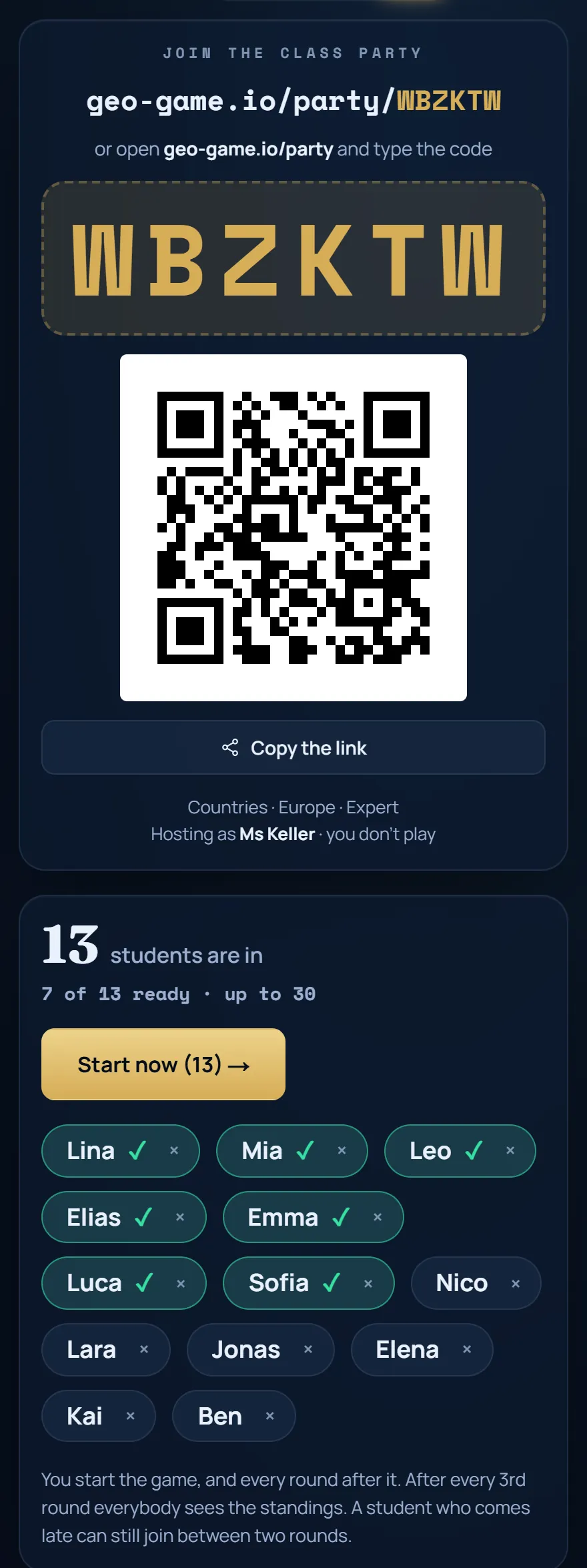
- Share the link or the code. Put it on the board, in your class chat or in your learning platform. Students open it in a browser, type their first name and they’re in. Without the link or the code, nobody can join.
- Watch the class come in, then press “Start now”. Your screen is made for the projector: the code in big letters and a QR code for phone cameras, and every name appears as the student joins; a ✓ shows who has pressed “I’m ready”. Only you start the game, it never starts by itself. A name that doesn’t belong in class? Press the × next to it: the name disappears at once, and the student can join again with another name.
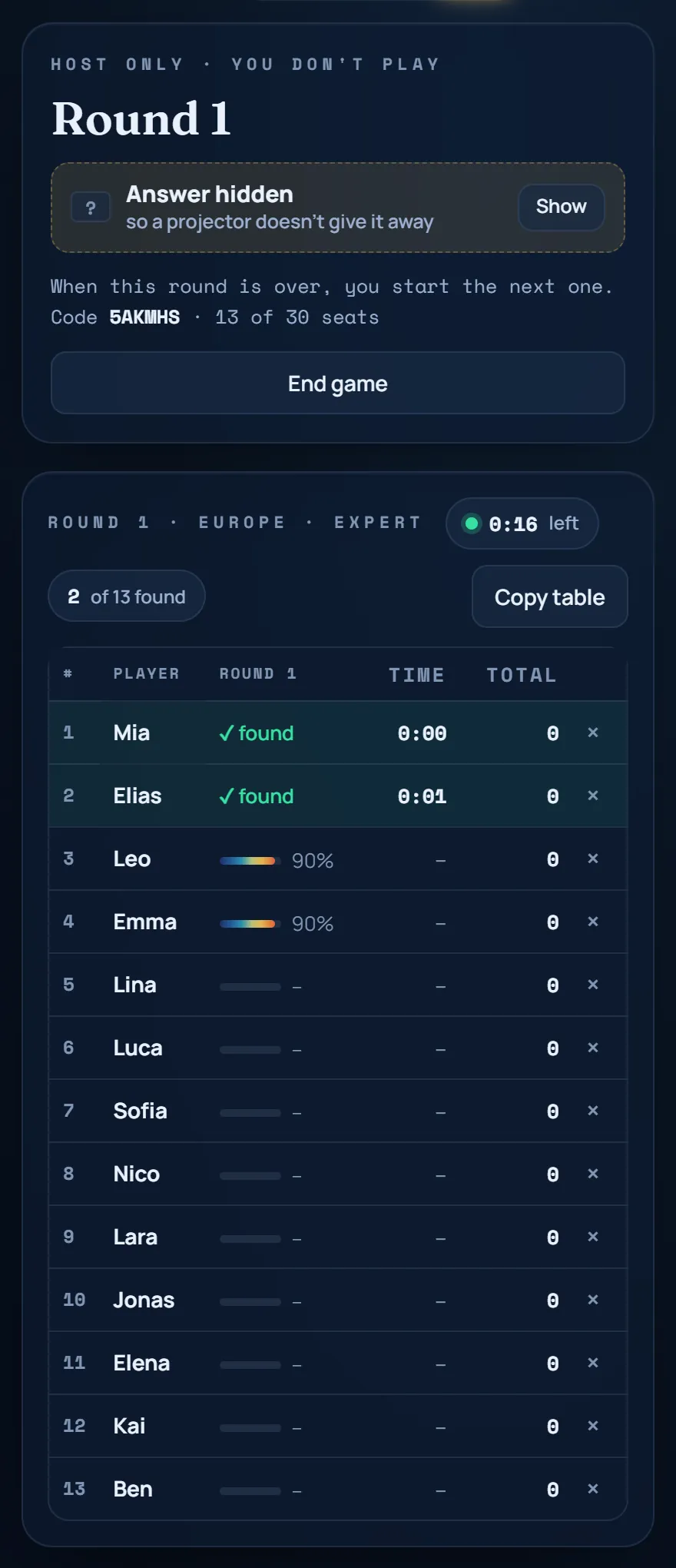
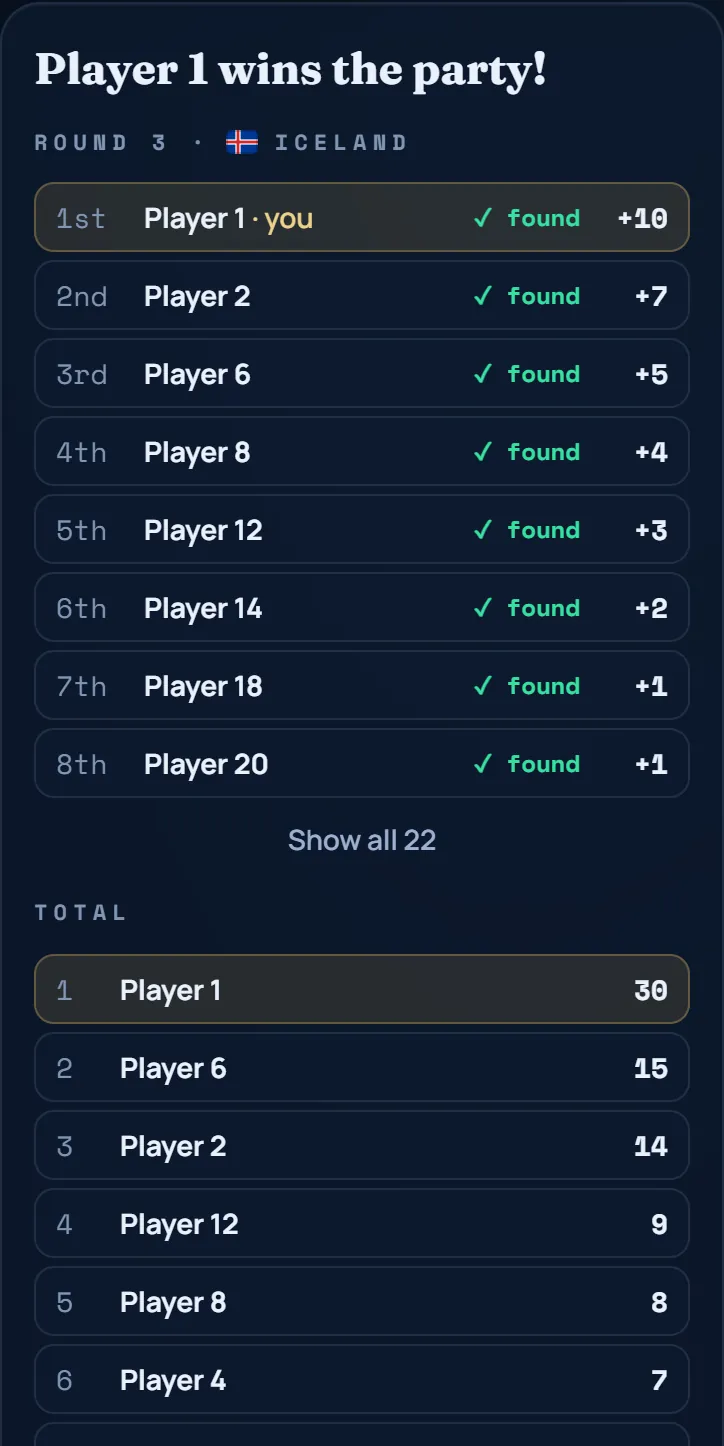
- Play, round by round. After a 3-2-1 countdown, everyone searches for the same hidden country. When the first player finds it, the others have 20 more seconds; after 4 minutes a round ends anyway. Points go by place (10, 7, 5, 4, 3, 2, then 1; the last place scores nothing). Instead of the globe, you see a live table: who has found it, how many guesses, the time and the points. The answer stays hidden, so the projector doesn’t give it away, until you press “Show”. After each round the class waits for you: press “Next round” when you want to go on. A student who comes late can still join between two rounds, with the code or the QR code on your screen, and plays from the next one.
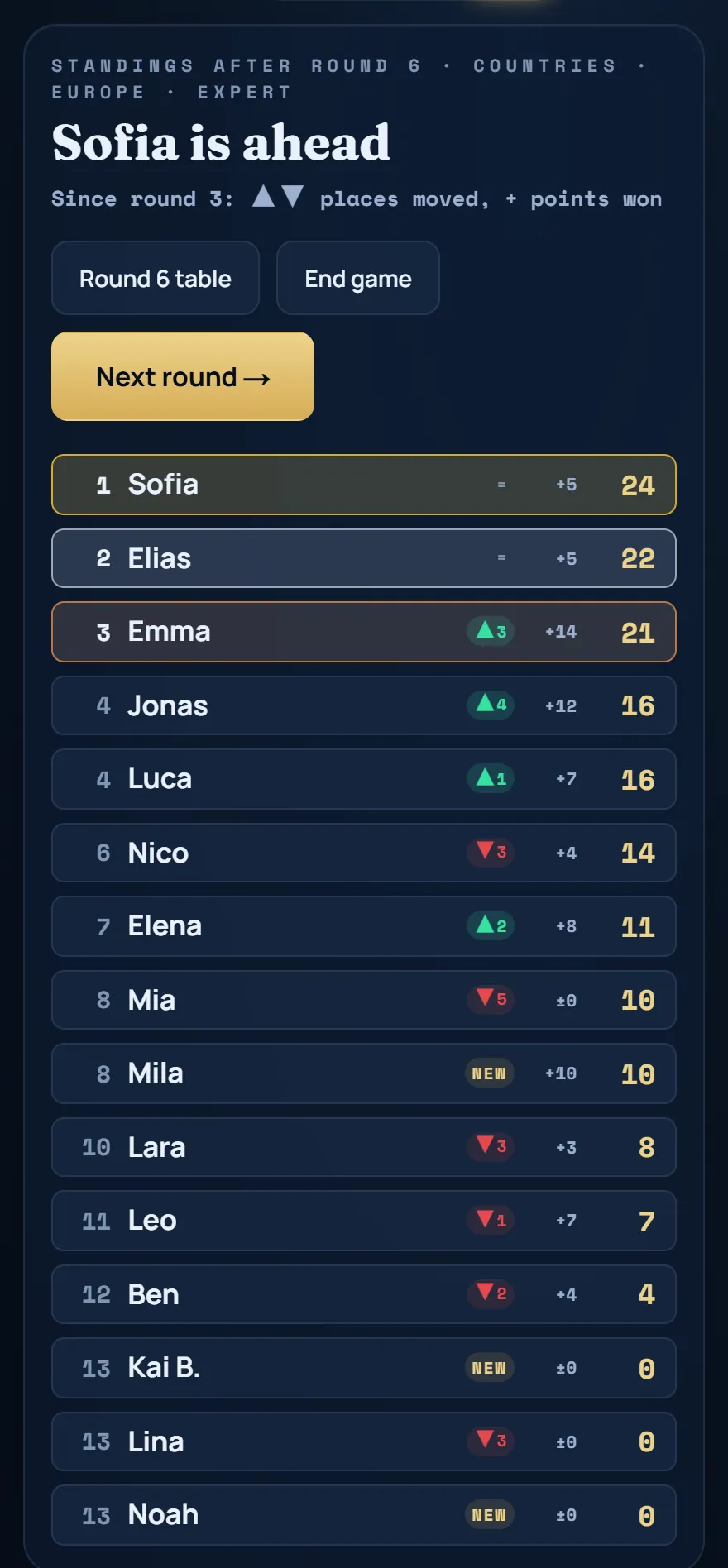
- Standings, and the end. After every third round (3, 6, 9 …) the standings fill your screen and every student’s: who is ahead, the points, and how many places each student has moved since the last standings. Between two rounds you can also open them yourself (“Standings”). The game runs as long as you like: “End game” shows everybody the final standings, and “Copy table” copies your table with every round, ready to paste into a spreadsheet. After 50 rounds the game ends by itself.
Rather play along? Create the party with the normal form instead (Party): set the number of players and choose “I play too” under “You”. Then you take one of the 30 seats, and the game waits until you are ready too (or until you press “Start now”); in the game you see the globe like your students.
No accounts needed
Students just type a first name or a nickname. No sign-up, no email, no password, and no age limit: students play as guests, no account needed. Party names are only shown to the other players in that party, and the party is deleted automatically after 3 days without activity.
Tip: names in a private party are not filtered automatically. Ask students to use their first name or a class nickname. If a name doesn’t belong in class, remove the student with the × next to it, in the lobby or during the game: the name disappears from every screen, and the student can join again with another name.
Works on the devices you have
GeoGame runs in any modern browser. Nothing to install, no app store.
- Chromebooks, laptops and PCs
- Tablets (iPad and Android)
- Phones
Students can mix devices in one party. The 3D globe needs a reasonably recent device and browser (WebGL); on very old machines it can be slow.
Privacy and safety
- No ads, and we don’t sell data.
- No tracking cookies. We only use the cookies needed to sign in, and students playing without an account don’t need them.
- No accounts, no email addresses. A party keeps the names players type, the countries they guess and the points, and deletes all of it after 3 days without activity. What stays is anonymous: game statistics without names, and for parties of three or more a Party Elo rating under a random guest number (not in teacher mode).
- Anonymous statistics. We count things like page views and finished rounds as plain totals that can’t be traced to a person (Vercel Analytics and our own counters).
- Hosting. The site is hosted by Vercel and the database by Neon. Both may process data outside Switzerland and the EU, with standard contractual clauses in place. Details are in our Privacy Policy (Swiss FADP and EU GDPR).
- Questions? marco@valena.ch
Lesson ideas
- Warm-up (5 minutes): one round at the start of the lesson. Ask the winner: “Which clue gave it away?”
- Continent focus: after a round, show the answer on the projector (“Show”) and ask the class to name all the neighbours of the hidden country.
- Think aloud: one student plays on the projector, and the class suggests the next guess and explains why (“Egypt was warm, so let’s go south”).
- Revision: a 10-round party at the end of a unit on Africa, Europe or Asia, with that continent as the region, so every hidden country lies there. Ask students to write down the countries they didn’t know and look them up afterwards.
- Capitals: once the class knows a continent, play the same region with “Find” set to “Capitals”.
- Class vs. class: two classes each play a party with the same number of rounds and compare how many guesses the winners needed. Or play one big party with both classes (up to 30 players).
- Homework: the free daily country is the same for everyone in the world. Students can play it at home and compare tomorrow how many guesses they needed.
Questions teachers ask
Is GeoGame really free for schools?
Yes. GeoGame is free to play, including parties for a whole class. There are no ads and no paid version you need.
Do students need to know the English country names?
No. The game is in English, German, French, Italian, Spanish and Portuguese (the language button switches it), and students can type country names in German, French, Spanish, Italian, Portuguese, Dutch, Polish and nine other languages written in the Latin alphabet, with or without accents. Names in other scripts, such as Cyrillic, Arabic or Chinese, are not recognised.
What age is it for?
There is no age limit: students play as guests, no account needed. They read and type country names (with suggestions as they type), so it suits classes that can do that comfortably.
Do my students need an account or an email address?
No. Students join with the link or the code and type a name. Nobody needs to sign up.
How many students can play at once?
Up to 30 students in one class party. You take no seat, so all 30 seats are for students; if you play along in a normal party, you take one of them. With a bigger group, split the class into two parties.
How long does a game last?
As long as you like: you start every round with “Next round” and end the game with “End game”. A round takes 1 to 4 minutes, and after every third round everybody sees the standings. After 50 rounds the game ends by itself.
What if a student drops out or closes the tab?
They can open the same party link again on the same device and browser, and they’re back in their seat. A student who comes late can join between two rounds and plays from the next one, starting with 0 points.
Does it work on our school Wi-Fi?
GeoGame runs over normal HTTPS in the browser: no app, no special ports, no plug-ins. If your school network allows regular websites, it works. If it blocks unknown sites, ask your IT team to allow geo-game.io.
Can strangers join our game?
Not a private party: only people with your link or code can join, and you can remove anyone at any time.
Are student names checked?
Names in a private party are not filtered automatically. Ask students to use their first name or a class nickname. If a name doesn’t belong in class, remove that student, in the lobby or during the game: the name disappears from every screen, and they can join again with another name.
What data do you store about my students?
Only what the party needs: the names they type, their guesses and their points, deleted after 3 days without activity. There are no accounts, no email addresses and no ads. What stays is anonymous: game statistics without names, and for parties of three or more a Party Elo rating under a random guest number (not in teacher mode).
Do I have to play myself?
No. The class form is teacher mode (“Host only”): you don’t play and take no seat. You start every round, you see a live table of every student, the answer stays hidden until you press “Show”, and when you end the game you can copy the table into a spreadsheet. If you’d rather play along, create a normal party and choose “I play too”: then you take one of the 30 seats.